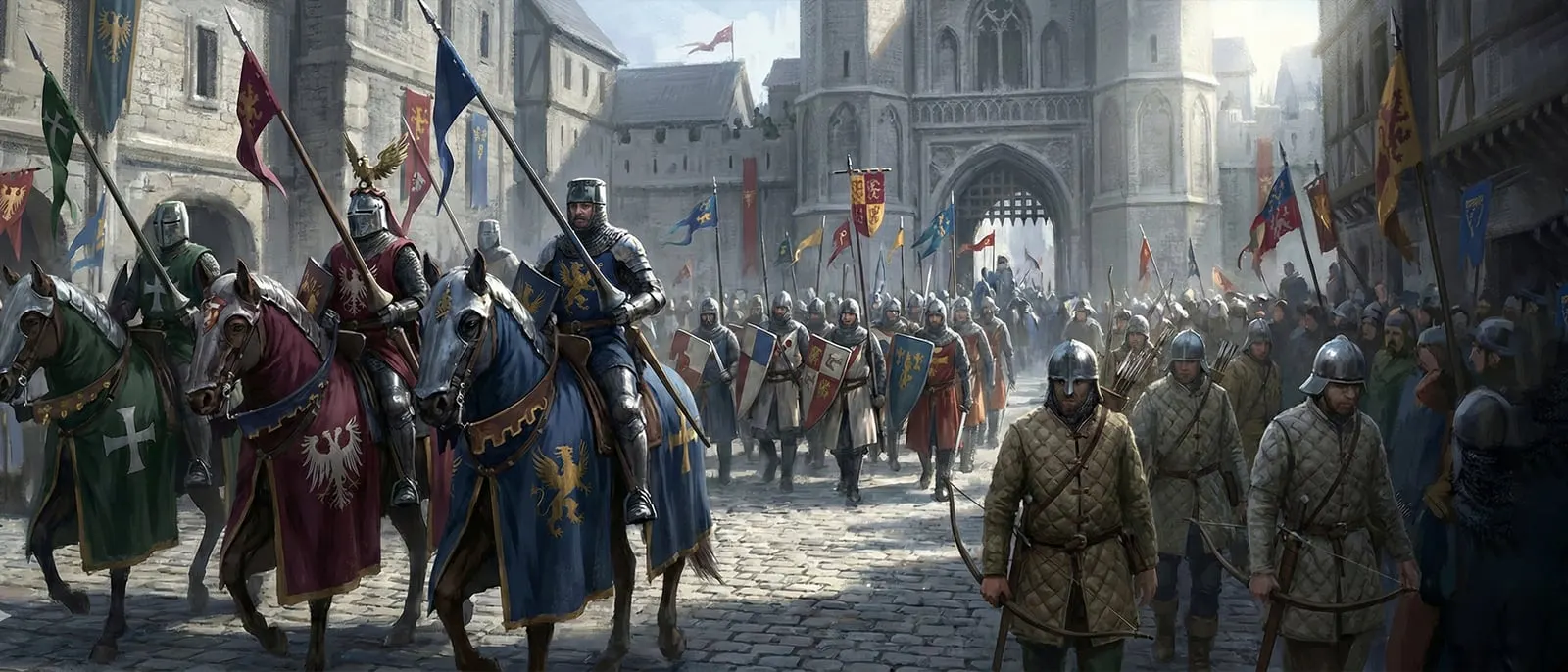
This continent does not reward lone riders. Hunt Bandits, crush Rebels, raise your first banner over your own walls — but look past your starting provinces toward the resource provinces and the Core Province, and the truth is plain: the Sandbox Map is not won by a city, but by a web of oaths.
Why Alliances Exist — Scarcity Forges Diplomacy
The continent is layered like a cut fruit: starting provinces → resource provinces → the Core Province, tightening ring by ring. Each ring is sealed by mountain passes and river fords — Level 9 and 11 passes on the outer ring, rising to Level 16 passes that guard the Core Province. Each is unique, scarce, irreplaceable.
Two consequences:
- You cannot hold every road. Choose one, defend one, surrender one.
- Every choice is a diplomatic event. If a neighbor seizes the pass into the resource provinces first, your road there runs past their gate. You either send a relation request — or march.
Reach inward alone, and only two endings remain: join an Alliance, or be ground beneath one. Only an Alliance can claim territory, build passes, and occupy the Core Province. Its highest honors belong to Alliances alone.
Diplomacy — Not a Button, a Covenant
Alliances conduct a range of diplomatic relations, designed to deepen interaction and strategy between players — no friend-or-block toggle, but a covenant with a formal process:
- You submit a relation request; the other side accepts.
- Both Alliances gain matching markers on the world map.
- The rules of war rewrite themselves: allied vision, rights of passage, joint-attack efficiency, the price of betrayal — all counting from that moment.
Social play leaves the chat box for the map itself: a banner outside a Level 16 pass is not a message, but a covenant written on the land.
The exact roster of relations (friendly, allied, hostile, neutral) follows official in-game announcements.
Fighting as One
Alliances command an exclusive tier of structures — means of production and coordinates of war:
- Mountain passes / river fords: routes and rights of passage, the physical fuse of every conflict.
- Alliance Fortress: the pivot for rallying, staging, and defense.
- Alliance Boss Lair: high-tier PvE no single Lord can break, besieged together, its spoils shared.
When two Alliances eye the same contested pass, the negotiating table and the battlefield are one map: not ten players pressing a rally button, but ten oaths staked upon a single chokepoint.
Not a "Guild"
If early documents said "guild," forget it. The official term is Alliance. A guild is a room where people talk; an Alliance is a polity — holding territory, signing covenants, bearing the cost of betrayal together. This is not a chat app with a map bolted on. This is a map that summoned a politics into being.
Beyond the Screen
The continent spills past the screen. Discord — the `#📜│chronicles` forum and recruitment channels — is its post-house: recruitment, cross-server intelligence, diplomatic talks, declarations of independence, battle reports. Reddit r/CinderNCrowns holds the long-form war histories and Alliance annals.
The covenant you sign lives among real people. What keeps an Alliance alive is not a Level 16 pass. It is the player still drawing battle plans at three in the morning.
Join the official Discord: <https://discord.gg/efjTvk9hPn>
Alliance mechanics
Beyond the banner, an alliance runs on roles, level-based growth, a shared economy, facilities, and warfare. Figures still being tuned during testing are noted as such.
Membership & roles
An alliance is led by a Leader, with Deputy Leaders, a Commander and a Diplomat, and eight troop Captains beneath them; plus a City Lord appointed for each captured city. Permissions are tiered by role — member management, alliance upgrades, technology, facility construction, and the treasury (tax and payouts, Leader only). The Leader's seat can be transferred or impeached.
Levels
An alliance gains levels through its members' activity. Its member capacity rises with level, from 65 to 160, and higher levels also lift resource-field output and the caps on alliance camps, sandbox banners, and claimable cities. (The level ceiling and experience curve are still being finalized.)
Joining & founding
A player founds an alliance after reaching a set home-city level and paying a gold cost (both configurable), becoming its first Leader. Joining offers three approval modes — open (auto-accept), conditional, and manual review — gated by having unlocked the system, not already belonging to an alliance, the alliance not being full, matching season progress, and having entered the sandbox.
Economy: resources & treasury
Alliances pool five resources — wood, stone, grain, iron, and F-Coin. These flow in from a tax on members' gathering plus over-time output from resource fields, captured cities, and alliance level, and are spent on construction, troop training, and member payouts. The Leader sets the gathering tax rate (within a configurable band) and may hand out F-Coin to members (delivered by in-game mail). Wood, stone, grain and iron have storage caps and can be plundered by attackers; F-Coin has no cap and cannot be plundered.
Facilities
On the map an alliance raises its own structures: siege engines (siege carts), camps (alliance and siege camps), banners, defensive works (arrow towers, caltrops), and resource fields (wood, stone, grain, iron). Each type has a build limit.
Technology, warfare & modules
Alliance technology unlocks at a higher alliance level (exact level still being finalized) and is upgraded with alliance resources for bonuses such as resource-field output. From level 1 an alliance also opens its shop, alliance cities, tasks, diplomacy, and warfare — bandit suppression, sieges, and alliance-boss campaigns.
Diplomacy
Alliances form four tiers of relation — Federation > Allied > Neutral / Hostile. Cancelling a positive relation drops straight to Hostile (never back to Neutral), and allied or federated alliances share battlefield vision. (Full relation rules follow official in-game announcements.)