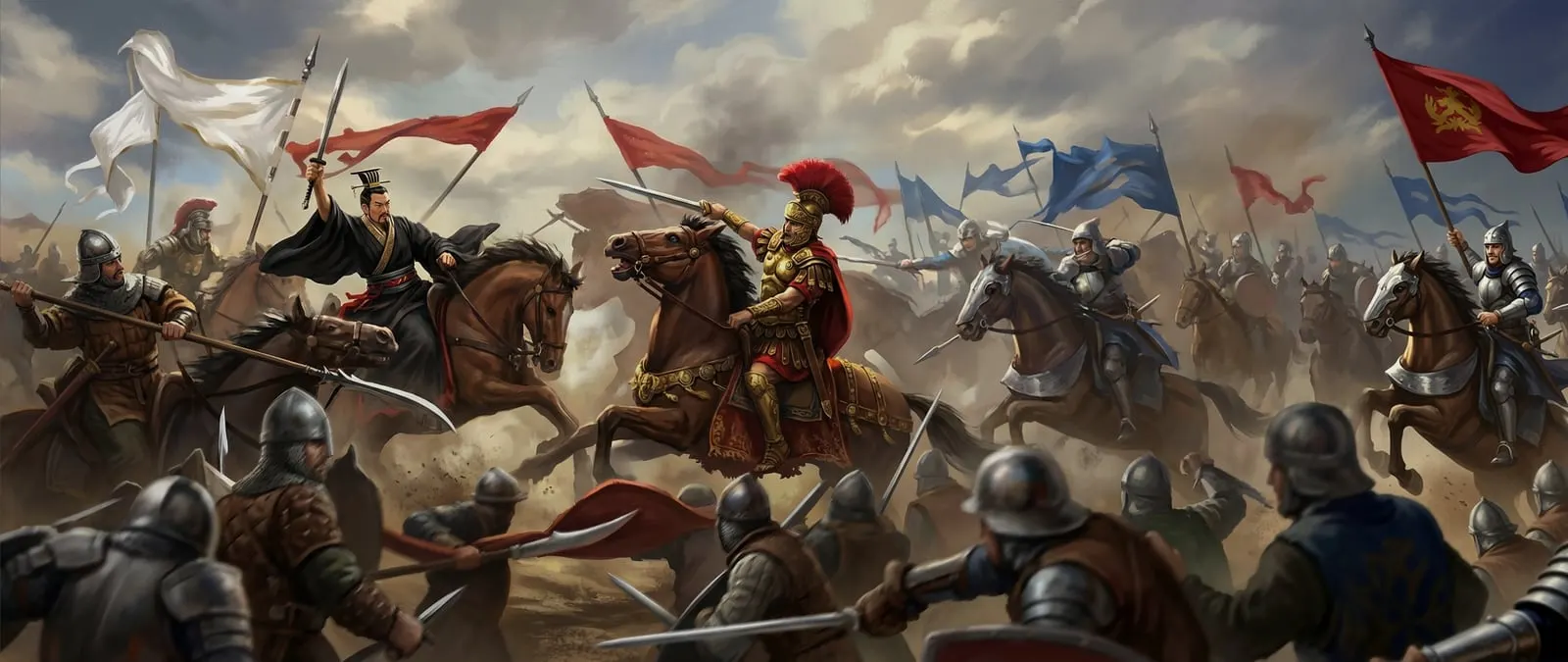
In Cinder & Crowns, much of a hero never leaves the designers' tables. Troop type does. It is the first attribute on every hero's page — a choice you, the Lord, make before any army marches.
The Three Troop Types
Each of the 30 heroes belongs to one type: 10 Infantry, 10 Cavalry, 10 Archers. They form a closed triangle: Infantry beats Archers, Archers beat Cavalry, Cavalry beats Infantry — a ±2% counter edge (the countering side deals 2% more, the countered side takes 2% more). Counter-buildings, unlocked through city upgrades, are designed to add a further edge on top, with exact values still being tuned. No type is strongest — only right for the battle at hand.
Infantry: Foundation of the Line
The continent's oldest way of war: shields raised, ranks closed, first wall of the city, spine of the march. Lords use one word: reliable. Among its ten (William Wallace among them):
- Yi Sun-sin (Korea) — tank and counter-striker; his skill hits harder the more outnumbered you are, the turtle ships' few-against-many made flesh. Breaks burst attackers.
- Cyrus the Great (Persia) — tank and buffer; Achaemenid founder, born to absorb punishment.
- Qin Shi Huang (China) — tank and support; the anchor at the line's center.
- Spartacus (Rome) — damage and tank; taunt, counterattack, high survival; led the Third Servile War.
- Toyotomi Hideyoshi (Japan) — control and debuffer; disarms melee damage-dealers.
- Richard I (England) — damage and debuffer; led the Third Crusade.
Archers: Death from Afar
They never hold the first rank, yet often decide the battle: suppression, focus fire, control at the critical moment. Ten seats (Seondeok among them):
- Thutmose III (Egypt) — damage and control; greatest of the conqueror pharaohs.
- Tomyris (Massagetae) — damage and debuffer; the steppe queen who slew Cyrus the Great.
- Artemisia (Halicarnassus) — damage and control; an exclusive trait grants +2 range — the ranged line's benchmark.
- Cleopatra (Egypt) — control and debuffer; wins by cunning, not arms.
- Tribhuwana (Majapahit) — damage and support; founder of the Majapahit dynasty.
Cavalry: Storm and Maneuver
The battlefield's most decisive work — flanking, shock, pursuit. When the line wavers, cavalry is the blade in the enemy's rear ranks. Ten in all:
- Julius Caesar (Rome) — damage and control; a charging dash that hunts ranged units; an exclusive trait raises damage against Archers.
- Saladin (Ayyubid dynasty) — survival and buffer; the legend who retook Jerusalem.
- Joan of Arc (France) — damage and survival; the farm girl who rode to war on a vision.
- Oda Nobunaga (Japan) — damage and debuffer; one of the Sengoku era's three great unifiers.
- Hannibal Barca (Carthage) — damage and control; crossed the Alps to strike Rome.
- Mulan (China) — buffer and survival; twelve years at war in her father's place.
- Chandragupta (India) — tank and buffer; founder of the Maurya dynasty.
Equipment Runs in Three Lines
Every hero wears four slots — weapon, helmet, armor, boots — each split by troop type into three separate arsenals, none interchangeable. The weapon forged for your Infantry vanguard will never serve your finest Archer.
Three types by four slots: 12 equipment lines, each its own long-term track. Committing to one type is not just a tactical style — it is a progression path that walks beside you for an entire Season.
Troop type is a real gameplay choice; a hero's homeland is only history. Two different dimensions entirely.