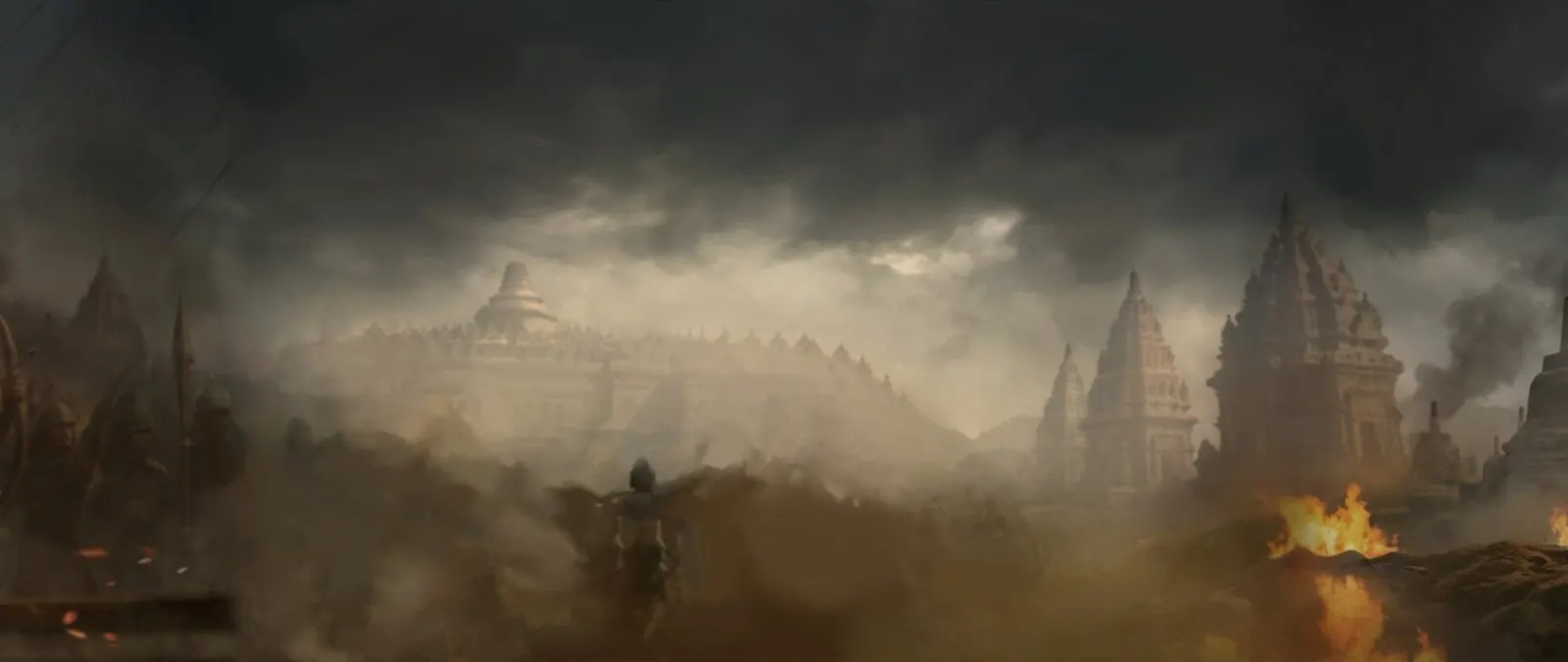
Rivers, Monsoon, and Sea
This is a vast homeland written by rivers, monsoon, and sea. At one end lies South Asia, where the Ganges pours down from the snows and lays the richest soil across its plain, cradling one of humanity's oldest civilizations. At the other lies Southeast Asia, where thousands of islands scatter across warm water and, deeper inland on the peninsula, rainforest and rice terraces hide temple spires that surface and vanish in the morning mist.
What stitches the two ends together is the monsoon. The wind that turns on schedule each year brings the rain that feeds everything and fills the sails of ships bound far over the water. In South Asia, civilization is born beside the river; in Southeast Asia, it grows great upon the sea. An invisible sea-road binds the spices of the Ganges delta, the rice of Java, and the gold of the peninsula into one breathing net.
From the Maurya to the Isles and the Peninsula
This land holds a span of history more than a thousand years long, unfolding from the land toward the sea:
- The Maurya Empire (4th century BC) — the first great power to unify northern India. Chandragupta rose around 321 BC and forged a strong, centralized state by an iron hand; his grandson Ashoka carried that empire to its height. One dynasty, both its founding and its transfiguration.
- The age of dharma after Kalinga — after the river of blood at the Battle of Kalinga, Ashoka turned away from conquest, embraced Buddhism, and governed by dharma, spreading benevolent rule and faith across South Asia and far beyond. The conqueror laid down the sword and became the moral compass of an age.
- The Majapahit Empire (14th century, Java) — the summit of Southeast Asian sea power. Under Queen Tribhuwana (Tribhuwana Wijayatunggadewi), the realm expanded swiftly across the archipelago toward its greatest extent — a dynasty that measured its strength in fleets rather than walls, in monsoons rather than borders.
- The Sukhothai Kingdom (Thailand) — a founding golden age on the Golden Peninsula. King Ramkhamhaeng opened the golden age of Sukhothai and is credited with creating the Thai script — with a single alphabet, he gave a people a root that would not perish.
These eras need not touch. They share one ground tone: from the Ganges plain to the isles of Java, from the stupa to the war fleet, civilization grows beside the water and travels far upon the wind.
Faith and Dharma, Monsoon and Sea, Dynasty and Temple, Script and Golden Age
Four words form the key to this homeland:
- Faith and dharma — Buddhism rose in South Asia and traveled outward along trade roads and sea lanes. Ashoka's pillars and edicts turned "rule by dharma" from a slogan into a promise carved in stone; the temple-mountains of Borobudur and Angkor raised faith into architecture the size of hills.
- Monsoon and sea — the pulse of this land. The wind's direction sets the season for planting and the season for sailing. The sea is no border between nations but a highway joining island, peninsula, and mainland.
- Dynasty and temple — here, kingship and the sacred are interwoven. A ruler is sovereign and guardian of the faith at once; the grandeur of a single temple is often the measure of a dynasty's might.
- Script and golden age — writing is a civilization's deepest root. Ramkhamhaeng's Thai alphabet gave a kingdom's golden age a shape that could be written down and handed on; and the name "Golden Peninsula" speaks both of real riches and of the flourishing ages that later generations would remember again and again.
These four words set the tone for everything in this land — its art, its faith, its halls of stone.
Four Names, One Arc
Among the thirty heroes of Cinder & Crowns, four hail from South and Southeast Asia, and together they trace this homeland's full arc from land to sea:
- Chandragupta (India, Cavalry) — founder of the Maurya Empire, who unified northern India around 321 BC and built a strong centralized state.
- Ashoka (India, Infantry) — the greatest Maurya emperor; after the bloody Kalinga war he embraced Buddhism and benevolent rule by dharma, spreading it across South Asia.
- Tribhuwana (Majapahit, Archer) — queen of the 14th-century Majapahit empire of Java, under whom the realm expanded across the archipelago toward its greatest extent.
- Ramkhamhaeng (Sukhothai, Cavalry) — king of Sukhothai in Thailand, who opened a golden age and is credited with creating the Thai script.
Their full stories belong to chronicles yet to come. For now they stand as the homeland's four coordinates: the iron hand that founds an empire, the king who laid down the sword for dharma, the queen of the isles, and the enlightened sovereign of the Golden Peninsula.