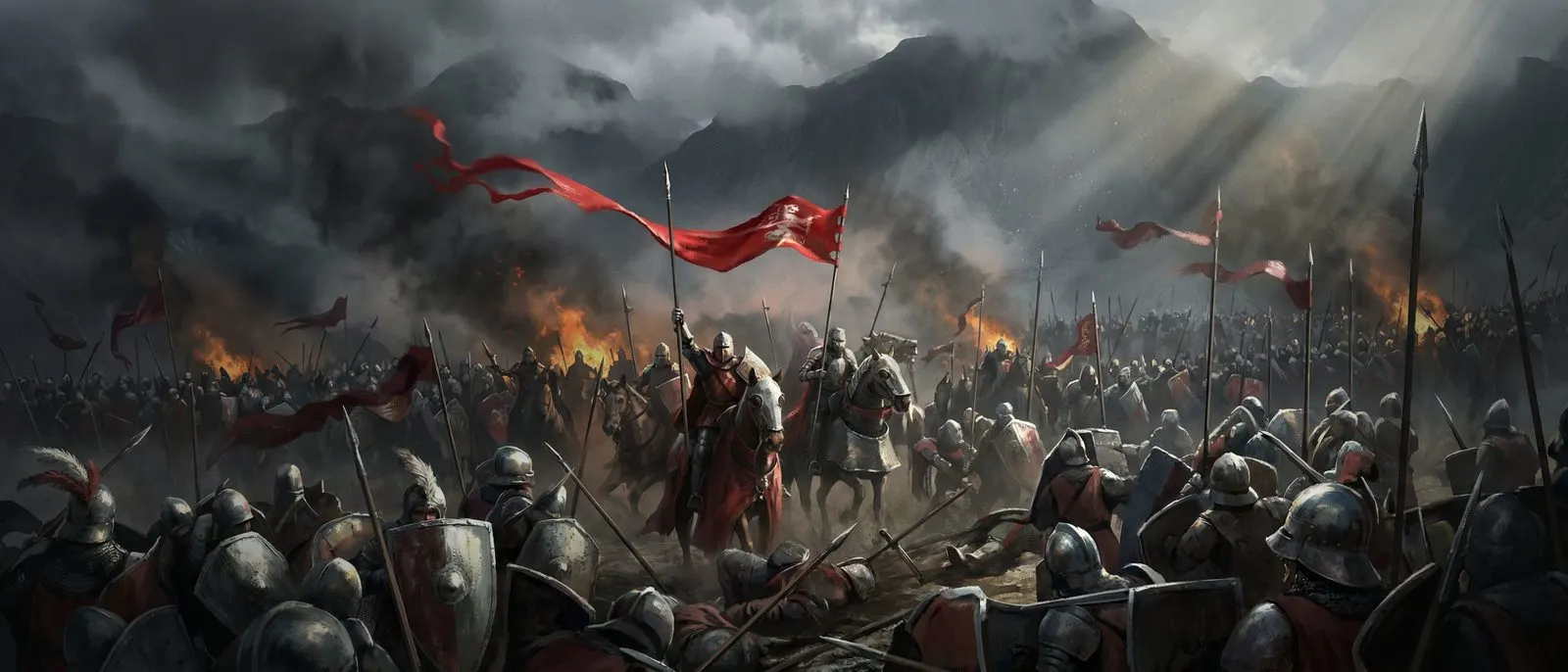
Battles in Cinder & Crowns resolve automatically. Your job is to build the right force and let the math play out. There are two modes: PvE duels, where a single hero fights monsters in the Adventure campaign, and sandbox battles, where full armies clash and hero-led troops fight troop-to-troop.
Heroes Lead, Soldiers Win
Your fighting force is heroes each leading a body of soldiers, and the soldiers are the bulk of your strength. Roughly 60% of battle power comes from your troops, and about 40% from the hero plus their equipment. Stacking great heroes is not enough on its own — the troops carry the fight.
The Damage Pipeline
Every hit resolves through a fixed pipeline, in this order:
- A small luck-based roll on attack and defense.
- Armor converts into damage mitigation — more defense means more reduction.
- Critical hits, with base critical damage about 150%.
- The troop-type counter.
- The hero's skill multipliers and flat bonuses.
Troop-Type Counter
The three troop types form a rock-paper-scissors loop: Infantry beats Archer, Archer beats Cavalry, and Cavalry beats Infantry. The base swing is small, about plus or minus 2 percent. Counter-buildings are designed to widen that gap.
Numbers vs. Quality
In sandbox battles, stacking more soldiers raises a unit's HP linearly, but its attack rises with diminishing returns. Sheer numbers help survivability more than raw damage — so composition and skills decide close fights.
Core Attributes
The core attributes are Health, Attack, Defense, and Critical. Heroes grow them through Hero Ascension and Equipment, while skills apply buffs, debuffs, crowd-control, and damage-over-time.