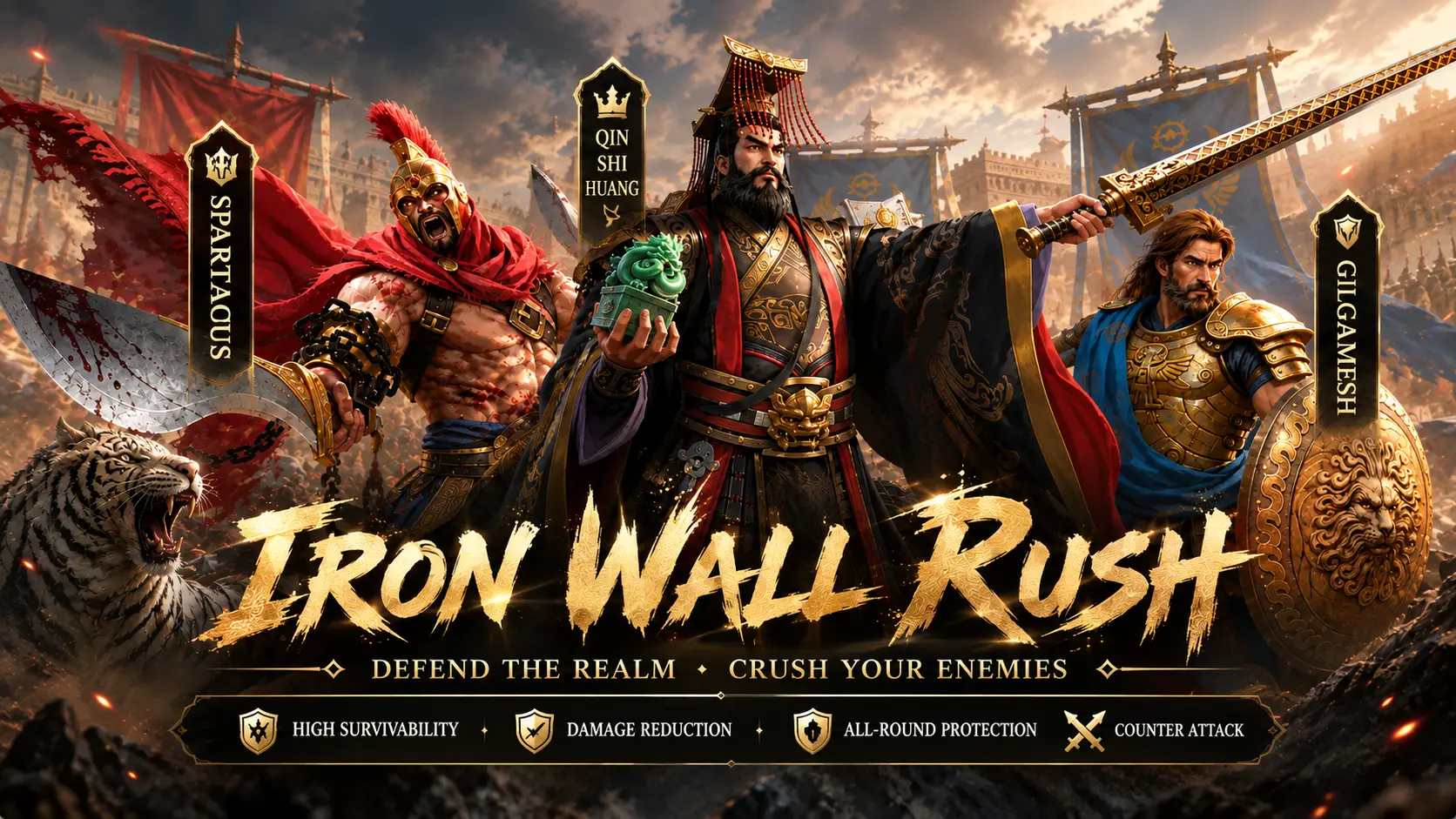
Guide Type: Lineup Recommendation
Recommended Rating: ★★★★☆
Recommended Lineup:
Spartacus + Gilgamesh + Qin Shi Huang
Lineup Role:
High Survivability|Damage Reduction|Shield Protection|Continuous Counterattack
Core Strategy:
Stabilize the battlefield first, then gradually gain the advantage through the frontline’s ability to absorb damage and launch counterattacks.
📌 Lineup Inspiration
This lineup concept is based on the current version’s hero skill mechanics, combined with practical frontline damage absorption and protection requirements in real battles.
If you also have a powerful lineup that you are currently using, feel free to share your battle compositions and strategies in the community. Let’s explore more possibilities together.
I. Lineup Overview
Recommended Lineup
Spartacus + Gilgamesh + Qin Shi Huang
Hero Roles
Hero | Troop Type | Role | Core Function |
|---|---|---|---|
Spartacus | Infantry | Counterattack Frontliner | Damage absorption, Taunt, Low HP Counterattack |
Gilgamesh | Infantry | Protective Frontliner | Shield, Guard, Damage Transfer |
Qin Shi Huang | Infantry | Core Tank | Damage Reduction, Armor, Team Shield |
Recommended Formation
Frontline:
Spartacus + Qin Shi Huang
Backline / Support Position:
Gilgamesh
Recommended positioning:
Let Spartacus take more frontline pressure, while Gilgamesh maintains his protection coverage. Qin Shi Huang provides stable team shields and damage reduction.
II. Core Mechanics of the Lineup
The Iron Wall Counterattack Build does not rely on instant burst damage to win battles.
Instead, it strengthens the team’s survivability through the skill synergy between the three heroes.
The overall battle flow is as follows:
Stage 1|Build the Defense Line
Qin Shi Huang
Provides:
Armor
Damage Reduction
Shield
He establishes the team’s basic survivability and creates the foundation for the entire formation.
↓
Stage 2|Absorb Damage
Spartacus
Uses:
Damage Reduction
Taunt
to actively attract enemy melee units and absorb frontline pressure.
↓
Stage 3|Counterattack
When Spartacus’ HP decreases:
He activates his Low HP Counterattack Mechanic.
The more frequently enemy melee units attack him, the more opportunities Spartacus gains to launch counterattacks.
↓
Stage 4|Protection
When Spartacus reaches low HP:
Gilgamesh
Uses:
Guard
Damage Transfer
to help share incoming damage.
↓
Stage 5|Regain the Advantage
Qin Shi Huang provides shields and damage reduction.
Gilgamesh provides protection.
Spartacus continues absorbing damage and launching counterattacks.
Eventually creating:
“The more enemies attack, the harder it becomes to break through.”
The biggest strength of this lineup is not that a single hero is extremely durable.
Instead, all three heroes’ skills revolve around:
Reduce Damage Taken → Share Damage → Absorb Attacks → Counterattack
Together, they form a complete defensive system.
III. Hero Analysis
Spartacus|The Closer He Gets to the Limit, The Stronger His Counterattacks Become
Spartacus is the true counterattack core of this lineup.
His skill set has three major characteristics:
① Active Skill Provides Damage Reduction
While attacking enemies in front of him, Spartacus increases his own damage reduction.
This allows Spartacus to further improve his ability to withstand damage after casting his active skill.
② Low HP Triggers Counterattack
This is the skill that best represents Spartacus’ identity as a counterattack hero.
When his HP falls below a certain percentage:
Receiving normal attacks from enemy melee units allows him to launch an additional attack.
This effect has a trigger cooldown.
In other words:
Spartacus does not simply become weaker when his HP decreases.
Once his HP reaches a certain level, he can turn enemy melee attacks into opportunities to counterattack.
His combat logic is:
Take Damage → Lose HP → Trigger Counterattack → Continue Fighting
③ Taunt Enemy Melee Units
Spartacus can periodically taunt random melee units, prioritizing enemy heroes.
This means he is not only capable of surviving damage himself, but can also actively attract enemy melee units.
This mechanic perfectly synergizes with his Low HP Counterattack ability.
The more enemies focus their attacks on Spartacus, the more opportunities he has to unleash counterattacks.
Gilgamesh|The Protection Core of the Entire Lineup
If Spartacus is responsible for:
“Taking hits and fighting back.”
Then Gilgamesh is responsible for:
“Making teammates able to withstand more damage.”
① Shield
Gilgamesh’s active skill provides himself with a shield.
This gives him strong personal survivability and allows him to stay on the battlefield longer.
② Protect Low HP Allies
This is one of Gilgamesh’s most important team protection mechanics.
He periodically guards the hero with the lowest HP.
When the protected hero takes damage:
Part of the incoming damage is transferred to Gilgamesh.
This means that when Spartacus enters a low HP state, Gilgamesh can further help him absorb pressure.
Creating the synergy:
Spartacus Low HP → Gilgamesh Guard → Damage Transfer → Spartacus Continues Counterattacking
This is one of the most important links in this lineup.
③ Team Critical Resistance
Gilgamesh can increase the critical resistance of allied heroes.
Therefore, when facing enemies that rely on critical hits for burst damage, this ability can further improve the team’s survivability and reduce the risk of being overwhelmed.
④ Ultimate Skill: Invincible Protection
Gilgamesh’s ultimate skill is unique:
After dealing damage to nearby enemies:
Gilgamesh enters an invincible state.
Nearby allied heroes receive reduced damage.
During critical moments, he can provide the team with an important survival window.
Qin Shi Huang|The Core of the Iron Wall
Qin Shi Huang is the most stable frontline hero in this lineup.
Compared with Spartacus, who focuses more on:
Damage Absorption + Counterattack
Qin Shi Huang focuses more on:
Armor + Damage Reduction + Team Protection
① Increase Own Armor
Qin Shi Huang’s active skill attacks enemies in front of him while increasing his own armor.
This further strengthens his frontline durability.
② Reduce Enemy Critical Rate
When the number of allied units is higher than the enemy’s, Qin Shi Huang can reduce the critical rate of nearby enemy units.
This is extremely important for this frontline-focused lineup.
The biggest threat to this lineup is not long-term damage.
The real danger is:
Enemy burst damage breaking through the frontline in a short period of time.
Reducing enemy critical rate helps lower this risk.
③ Team Damage Reduction
Qin Shi Huang can directly increase the damage reduction of allied heroes.
This works perfectly together with:
Gilgamesh’s Guard
Gilgamesh’s Damage Transfer
Spartacus’ own Damage Reduction
Creating a powerful defensive synergy.
④ Team Shield
Qin Shi Huang’s ultimate skill deals straight-line damage to multiple enemies in front of him while providing shields for allied heroes.
This gives the lineup three layers of survivability:
Qin Shi Huang Shield + Gilgamesh Shield/Guard + Spartacus Damage Reduction
IV. Lineup Advantages
① Extremely Strong Frontline Survivability
The skills of all three heroes revolve around:
Armor
Damage Reduction
Shields
Guard
Damage Transfer
Counterattack
Therefore, the biggest advantage of this lineup is that it is extremely difficult to break through quickly.
② Excellent for Long Battles
This lineup does not rely on dealing massive damage at the beginning of the battle.
Instead, it excels at:
Controlling the battle tempo
Extending the fight
Gradually reducing the enemy’s burst advantage
The longer the battle lasts, the more valuable the frontline protection mechanics become.
③ Strong Against Melee-Based Attacks
Spartacus’ Low HP Counterattack and Taunt mechanics make him especially effective against enemy melee units.
Therefore, against lineups that mainly rely on melee damage dealers, this formation can fully utilize its defensive advantages.
④ High Error Tolerance
Even if one frontline hero takes heavy damage, Gilgamesh’s protection and Qin Shi Huang’s team defensive abilities can provide support.
Compared with pure damage-focused lineups:
This lineup has a much lower punishment for mistakes.
V. Lineup Weaknesses
① Limited Burst Damage
All three heroes have strong survivability and protection abilities.
However, this also means:
The lineup’s overall burst damage is limited.
If the enemy has powerful sustained damage output and your team cannot quickly establish a counterattack advantage, the battle may turn into a prolonged war of attrition.
② Vulnerable to Cavalry Counters
Since all three heroes are Infantry units:
You need to pay close attention to troop counter relationships when facing cavalry-focused lineups.
③ Requires Good Battle Timing
The counterattack system requires the following process:
Damage Reduction → Absorb Damage → Low HP Counterattack → Protection → Continue Absorbing Damage
Therefore, this lineup can be pressured by high-burst compositions during the early stage of battle.
VI. Equipment Priority
Priority 1: Spartacus
Spartacus is the counterattack core of this lineup.
Recommended equipment attributes:
HP
Defense
Critical Resistance
Damage Reduction
Core goal:
Allow Spartacus to consistently enter a low HP state and continue triggering his counterattack mechanics during this stage.
Priority 2: Qin Shi Huang
As the core tank, Qin Shi Huang should prioritize:
HP
Defense
Critical Resistance
Damage Reduction
His main purpose is not to deal the highest damage.
His role is to maintain:
Armor + Damage Reduction + Team Shield
for as long as possible.
Priority 3: Gilgamesh
As a protection-focused frontline hero, Gilgamesh should also prioritize:
HP
Defense
Critical Resistance
Damage Reduction
His value comes from:
Guard + Damage Transfer + Protecting Allies
The longer he survives, the more stable his protection becomes.
💡 How to Upgrade When Resources Are Limited?
Recommended priority:
Spartacus ≈ Qin Shi Huang > Gilgamesh
Do not evenly upgrade all three heroes at the beginning.
First improve the equipment quality of the two core frontline heroes, then gradually complete Gilgamesh’s equipment.
VII. Alternative Hero Recommendation
If you have not obtained Qin Shi Huang in the early game, you can consider using:
Cyrus the Great
as a temporary replacement.
Cyrus the Great is also an Infantry hero and provides:
Control Immunity
Active Skill Resistance after Critical Hits
Increased Armor for allied Infantry heroes
Team-wide Control Immunity
Therefore, he can take on certain frontline and team-support responsibilities.
However, from the perspective of the complete Iron Wall Counterattack Build, Cyrus the Great is better suited as an early-game transition option rather than a final replacement for Qin Shi Huang.
The reason is:
Qin Shi Huang’s:
Damage Reduction + Armor + Team Shield
fits much better with the defensive system created by Spartacus and Gilgamesh.
VIII. Summary
The Iron Wall Counterattack Build is a classic defensive counterattack formation.
By using Qin Shi Huang to establish the team’s defensive foundation, Gilgamesh to continuously protect allies, and Spartacus’ Low HP Counterattack mechanics, the lineup creates a complete cycle of:
Absorb Damage → Protection → Counterattack
This lineup does not aim to defeat enemies instantly.
Instead, it relies on stable survivability to gradually build an advantage and eventually secure victory.